We Asked the AI Everyone’s Calling the Next “DeepSeek Moment” to Review NSAuditor AI Enterprise
Zhipu’s open-weight GLM-5.2 reviewed the NSAuditor AI Enterprise architecture. Here is its read — and the hard parts it flagged.
Zhipu’s GLM-5.2 is the open-weight model the AI world keeps calling the next “DeepSeek moment” — a permissively licensed system sitting within a point of the top US models on agentic benchmarks, at a fraction of the cost, with developer adoption climbing fast. So we did something direct: we handed it the full architecture of NSAuditor AI Enterprise and asked it to evaluate the design critically.
What follows is its read, presented as it is. It is an AI model’s architectural review — not a customer reference or an auditor’s attestation — and the model itself was explicit that its assessment is conditioned on the code backing the pitch. With that framing, the substance was worth sharing.
One engine, not a stack of subscriptions
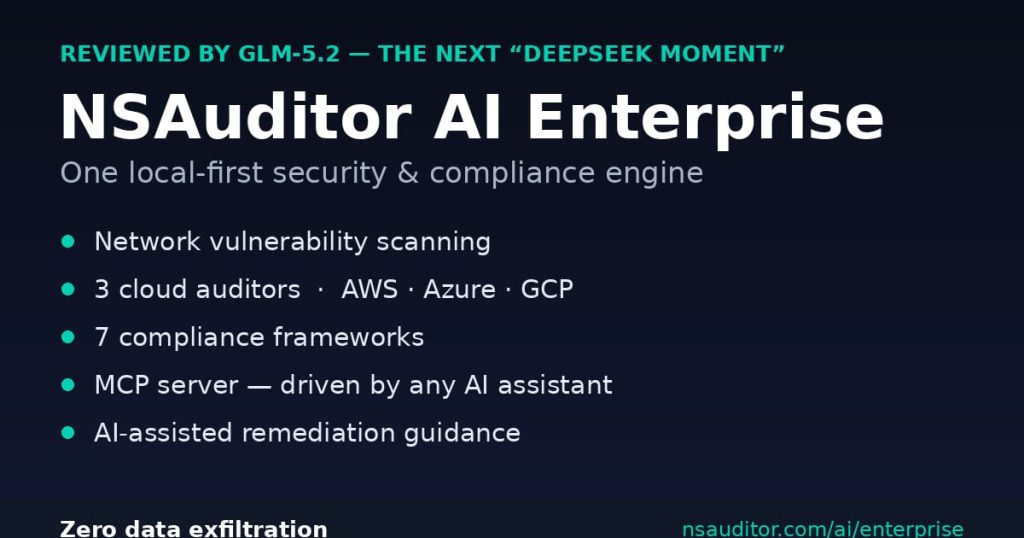
The model’s summary of what the product delivers, in a single local-first engine:
- Network vulnerability scanning
- Three cloud auditors — AWS, Azure, and GCP
- Seven compliance frameworks — NIST, CIS Controls v8, PCI DSS, ISO/IEC 27001:2022, HIPAA, SOC 2, and GDPR Article 32
- A Model Context Protocol (MCP) server
- An AI-assisted remediation layer
Its one-line verdict on that combination: “This is no longer just a network scanner. It is an AI-powered compliance and remediation engine.” The point it drew out is correlation — a finding from the network or the cloud can be mapped to the specific control it affects, inside one engine rather than three separate tools.
The part it kept returning to: zero data exfiltration
The design principle the review fixed on was data residency. NSAuditor AI Enterprise runs on the customer’s own infrastructure. Cloud API calls go from the customer’s environment directly to the provider, and AI processing can run against a local model or a private instance. Configuration and identity data never leave the customer’s VPC.
As the model put it, this is the structural advantage that an agent-based SaaS model cannot easily match: the data does not have to be piped to a third party to be processed. For regulated teams — finance, healthcare, defense — that is frequently the deciding factor.
MCP: the eyes and hands of any AI assistant
The review singled out the MCP integration as the most forward-looking part of the architecture. Because the scanning and compliance capabilities are exposed over the open Model Context Protocol, any MCP-aware AI assistant can drive them — trigger a scan, check an environment against a framework, and surface context-aware remediation guidance. In its words, this makes the tool “the eyes and hands of any AI assistant, not just a closed-loop chatbot.”
It did not only flatter us
A useful review names the hard parts, and this one did. It flagged cloud API rate limiting and the depth of IAM work required to map several frameworks across three providers; it noted that automated control mapping has to earn trust with auditors over time; and it cautioned that building a scanner, a multi-cloud auditor, an AI layer, and an MCP server at once is a substantial undertaking.
Those are fair, and they are exactly where the engineering work is concentrated. We would rather publish the caveats than pretend they do not exist.
Read the code, not the score
The model’s rating was for the vision and architecture, explicitly conditioned on the implementation living up to it. That is the right way to read any review like this. The most honest invitation we can extend is the same one the design implies: run it yourself, on your own infrastructure, where the data stays yours.
Learn more at nsauditor.com/ai/enterprise/.