The Scan You Can Send: NSAuditor AI Enterprise 0.44.0 Delivers a Client-Ready Report That States What It Covered
NSAuditor AI 0.44.0: a branded, print-ready report whose cover states scan coverage, and an S3 audit-trail finding that checks both AWS audit trails.
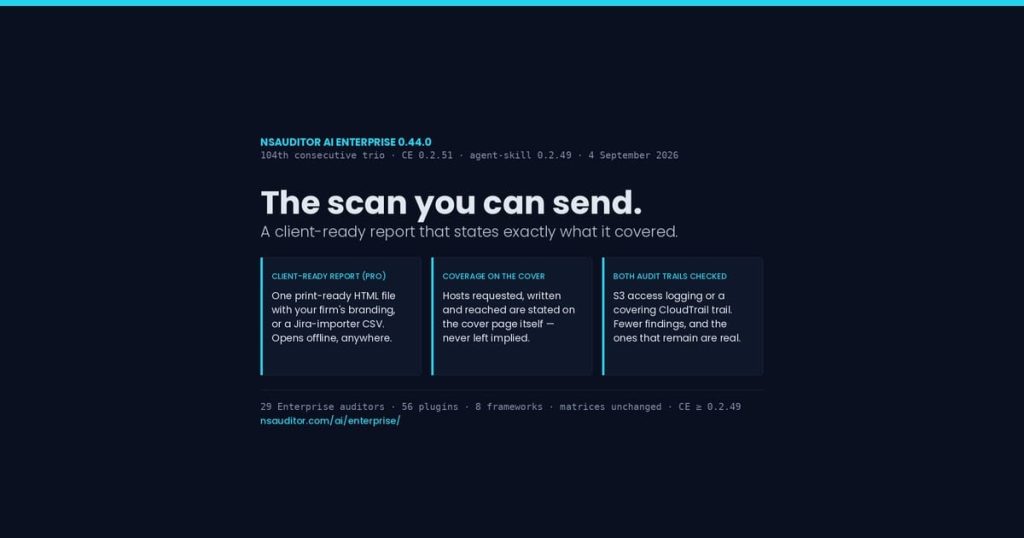
Las Vegas, Nevada — 4 September 2026. Nsasoft US LLC has released NSAuditor AI Enterprise Edition 0.44.0 alongside Community Edition 0.2.51 and agent-skill 0.2.49, the company’s 104th consecutive paired release. The headline is simple to state and hard to build: the scan you can send. A finished scan run can now be rendered as a client-ready report whose cover page states, in print, exactly what the run covered — and on the Enterprise side, the S3 audit-trail finding now reads both of the audit trails AWS actually offers, so a bucket that is already fully recorded by CloudTrail is no longer reported as unlogged.
A report you can hand to a client
Security consultants, MSSPs and audit firms rarely deliver a raw scanner output. They deliver a document. Until now that document was assembled by hand from the scan’s JSON and HTML artifacts, which is slow, error-prone and — more importantly — silent about whether the scan behind it was complete.
Community Edition 0.2.51 introduces the report subcommand for Pro licensees:
nsauditor-ai report --from <run-directory> --format executive --brand ./firm.json
nsauditor-ai report --from <run-directory> --format jira
The executive format renders a completed run as one self-contained, print-ready HTML file, with cover-page branding for the firm sending it. It carries no external network reference at all, so it opens on an offline laptop exactly as it opens online — a real consideration for the restricted environments NSAuditor AI is designed for. The jira format writes a CSV in Jira’s documented importer layout instead, for teams that track remediation as tickets rather than reading a document.
The cover page states what the scan covered
The feature that took the engineering effort sits underneath the report. Every scan now writes a per-run record: opened when the run starts, appended as each host completes under a per-run lock, finalized when the run ends. The report’s cover is generated from that record, so it states the number of hosts requested, the number written and the number actually reachable, rather than implying completeness by saying nothing. A run that lost a host or never finished says so on its own cover, and --allow-partial will still render it, with the caveat printed where the client reads it rather than buried in a log.
The reasoning behind this design carries through from the previous release, which taught every cloud scanner to report a provider it could not reach as not audited, with the reason. A confident-looking document about an estate that was never fully scanned is the most expensive kind of report a firm can send. NSAuditor AI now makes that document impossible to produce by accident.
An audit-trail gap now means both audit trails are missing
Amazon S3 object access can be recorded two ways: the bucket’s own server access logging, or an AWS CloudTrail trail configured to record data events for that bucket. Many mature AWS estates have standardised on the CloudTrail route. Enterprise 0.44.0’s S3 auditor now checks both streams. Where a trail positively covers the bucket — the whole bucket, reads and writes, trail running, log delivery healthy, region reached — the former access logging not enabled finding is replaced by a statement naming the covering trail, which the compliance report carries as positive evidence rather than as a violation. Three framework rationales were rewritten to match: SOC 2 CC7.1, HIPAA §164.312(b) and NIST SP 800-171 3.12.3.
The strictness is the point. Coverage is asserted only when it is positively established; a prefix-scoped selector, a read-only or write-only selector, a stopped trail or a region the scan could not reach all keep the original finding, byte for byte. The cross-check reports its own status once per scan, so an operator can always tell a real gap from a check that could not run. The result for the customer is fewer findings, and the ones that remain are real.
What stays the same
Eight compliance frameworks from one read-only scan — SOC 2, HIPAA, NIST CSF 2.0, PCI DSS v4.0.1, ISO/IEC 27001:2022, CIS Controls v8, GDPR Article 32 and NIST SP 800-171 Rev 2 — across 29 Enterprise auditors (28 cloud auditors + 1 Zero Trust posture check) and 56 plugins overall. Every coverage matrix is unchanged this cycle; the release deepens the evidence on controls already covered rather than widening the claim. Enterprise Edition 0.44.0 pairs with Community Edition 0.2.51 and agent-skill 0.2.49, and requires Community Edition 0.2.49 or newer.
As with every release, both editions run entirely on the customer’s own infrastructure with read-only credentials enforced in code, and no scan data is collected, transmitted or stored by Nsasoft. Enterprise Edition is published as @nsasoft/nsauditor-ai-ee on npm and requires a licence; Community Edition is nsauditor-ai and is free.
Full details, coverage matrices and the getting-started guide: https://www.nsauditor.com/ai/enterprise/